
DMEXCO 2026: More German, More Agentic
By Joe Campbell, Account Director
The Koelnmesse halls felt noticeably busier on my second trip to DMEXCO, which has clearly fully recovered from pandemic years. It’s also leaned into its national heritage – my German got a proper workout this year, with seemingly more sessions delivered in German than in 2024.
DMEXCO 2026 still held up a mirror to global trends in advertising and media, though, including the rise of agentic advertising.
It was hard to find a stand or presentation that didn’t have ‘agentic’ somewhere on it. It has become a bit of an echo chamber, yet agentic is inevitable now - from media owners to agencies to the tech in between; not having it on your sales deck is a notable gap.
While my first DMEXCO was all early-stage AI experimentation, this year’s motto, ‘Scaling Intelligence,’ suited a crowd that came to see and do it, not just talk about it.
Plenty of tasks are being successfully handed over to agents, giving hours back to the work that actually creates a buzz. However, in every session I sat in, the same question kept coming up: who or what controls the signal agents act on?
Agentic only scales when someone’s holding the wheel
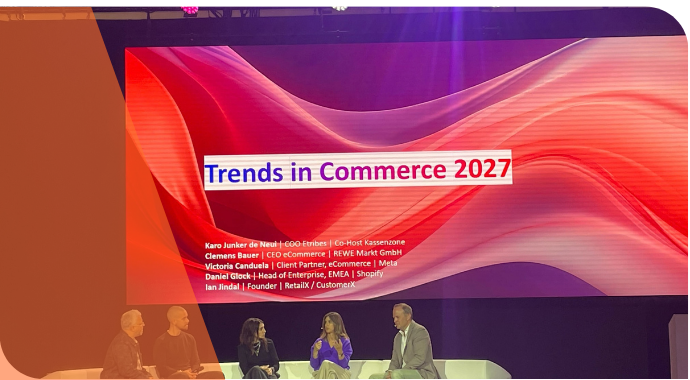
That question started with governance. The Trends in Commerce 2027 panel, moderated by Retail X’s Ian Jindal, pointed to real efficiency gains in agentic customer journeys. But the panel’s real point wasn’t the tooling; it was the groundwork needed. Providing non-specialists with AI only works if the organisation has already invested in the culture and training to back it up. You can’t scale intelligence if you haven’t built it first.
Creative had the same tension. Sir Martin Sorrell observed that AI platforms are genuinely changing content production and are raising the baseline of what ‘good’ looks like. But until we reach true artificial general intelligence, human judgement and inimitability is what sets work apart.
Commerce’s new measurement questions
BMW’s session with Taboola on launching the new iX3 model raised this governance question again. Susanna Eiber and Krishan Bhatia concluded that technology is the easy part. The hard part is redesigning the operating model so every funnel stage tells one consistent, emotional story. BMW had to rebuild their customer journey to make new signals usable and capture consumer intent.
L’Oreal put that rebuild to a test. Nadia Sommerfeld walked through a controlled experiment – a real test group against a real control group – pitting AI-driven signals against traditional first-party data. The AI models learned and outperformed, meaningfully improving efficiency. However, the lesson was that AI isn’t magic; it still needs high-quality data to learn from. Good signal beats a good algorithm.
What AI can’t manufacture
Reddit’s David Trencher drew a line under this in his session. The consumer journey isn’t linear anymore. People go into specific communities for honest, lived experience. The example on stage was the Reddit community he used for Barbour jackets: real people, real opinions, zero brand script. AI’s role there is real but bounded – it accelerates someone from a broad query to a specific decision. It doesn’t manufacture the trust that gets them there.
That distinction ran throughout the event: AI compounds whatever signal you feed it, good or bad, real or synthetic. It doesn’t originate the real thing itself – whether that’s the data, the story, the media thinking, or the trust behind it. That ultimately still needs to come from a human.